
Schemmer
Newsroom
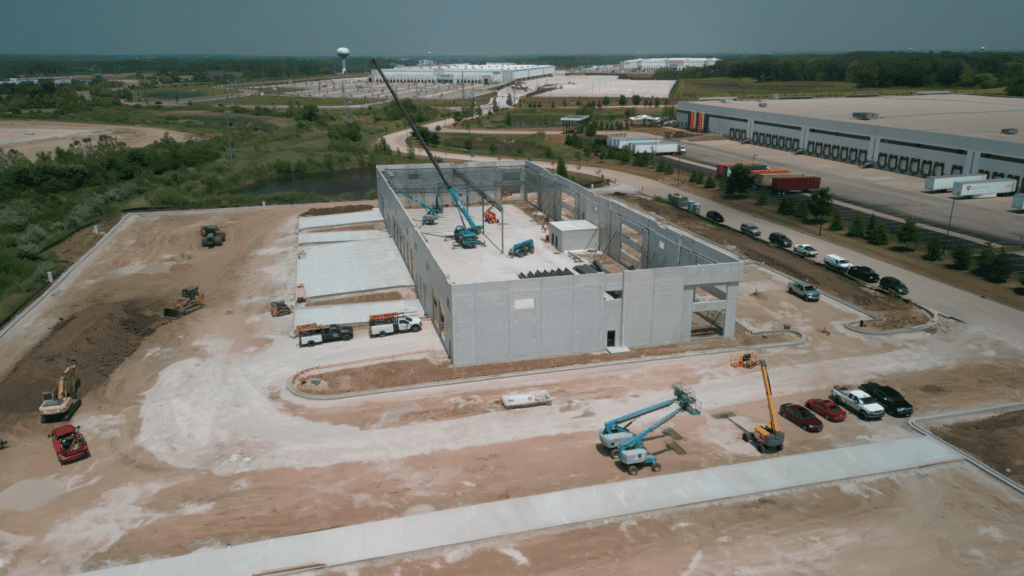
Why Building on Midwest Soils Starts Below the Surface
May 11, 2026 • All
When most people look at a construction project, they focus on what is being built. The building, roadway, bridge, or finished development usually gets the attention.
What people do not see is the work happening underground long before construction begins. That’s where geotechnical engineering comes in.
“Every time we build something, it is built on the earth,” said Geotechnical Engineer Ben Ficenec. “Knowing how the earth will behave is crucial to building a stable foundation.”
In the Midwest, that can become complicated quickly.
Why Midwest Soils Can Be Difficult
Much of the Midwest was shaped by rivers and streams that shifted over time. In many places, levees and channels were built to keep water from changing course. It solves one problem, but creates another.
“When working in areas adjacent to these channels and streams we find soft soils where water once flowed,” said Ficenec.
That soft soil left behind is not always ideal for supporting heavy structures. These soft soils are often very compressible and will settle beneath buildings, roads, and infrastructure. Sometimes the effects appear quickly. Other times, they take years to become noticeable. A lot of the problems people see around buildings and pavement can actually start underground.
“These include cracking of pavements and floor slabs as well as structural failures in door and window frames,” Ficenec explained.
What looks like a sticking door or cracked concrete slab may actually be the result of the ground settling underneath. If ignored long enough, these issues can lead to major structural failures.
Problems Underground Can Change Everything Above It
One project that stands out to Ficenec is the development at 72nd and Farnam in Omaha.
The site sits on top of the former path of Papillion Creek, which left behind soils too weak to support the structure without additional preparation. Before construction began, Schemmer recommended subgrade improvements to strengthen the site.
“In simple term, the soil conditions required improvements beneath the surface before the building could be constructed,” Ficenec said.
Of course, that came with some additional costs, but identifying the issue early helped avoid much larger risks later. This is why geotechnical engineers are often brought into projects during the early design stages. Understanding how soil will behave gives project teams more flexibility before construction starts.
Water Is One of the Biggest Factors
Water plays a major role in how soil behaves. This is especially the case in the Midwest. Ficenec compares it to building a sandcastle.
“If it’s too dry, it falls apart into a pile of dry sand. If it’s too wet, it slumps over and washes away.”
The right balance of moisture helps hold soil particles together. Too much or too little can change the way we expect the soil to behave. In clay soils, those problems do not always show up right away.
“Buildings and pavements that appear to be in good condition after construction can start to develop problems over time as the subsoils continue to compress,” Ficenec explained.
Rain, snow, groundwater, and seasonal weather changes all affect the why in which the soil behaves. Clay soils can be especially sensitive because they expand and shrink as moisture levels change.
Solving Problems Before Construction Starts
One of the biggest advantages of geotechnical engineering is that it helps teams make informed decisions before a project ever reaches construction. In some cases, understanding how soils will behave allows engineers to adapt the design itself instead of spending significantly more money trying to eliminate every settlement risk.
Ficenec pointed to large storage tanks as one example. A full storage tank can place enormous pressure on the soils below it. Rather than completely rebuilding the subgrade, mechanical engineers that are made aware of settlement issues ahead of time may recommend flexible piping systems that can tolerate some movement over time.
“This can be a much cheaper option than trying to modify the subgrade,” said Ficenec.
That kind of coordination between disciplines can save projects substantial time and cost while reducing long-term risk.
A Field Built on Science and Investigation
Geotechnical engineering combines geology, physics, testing, and practical construction knowledge. According to Ficenec, there is also far more science involved than many people realize.
“We have to be able to use math to explain how things behave,” he said.
For Ficenec, the process of solving problems is one of the most rewarding parts of the profession.
“You need to develop a hypothesis, perform experiments, analyze the findings, and develop rational conclusions,” he said. “I enjoy using the scientific process to solve problems.”
Most people may never see the work geotechnical engineers do firsthand. But long before the first concrete is poured, their work helps determine how well a project performs for decades to come.
SCHEMMER – ARCHITECTURE|ENGINEERING|+
At Schemmer, we believe that great design goes beyond structures; it strengthens communities. As a full-service architecture, engineering, and construction field services consultant, we deliver innovative solutions that enhance the built environment and improve lives.
Since 1959, we have been shaping the future while honoring our legacy. With nine offices across six states in the Midwest, our expertise reaches coast-to-coast, bringing thoughtful, sustainable, and impactful solutions to every project.
Our Comprehensive Services:
- Architecture
- Structural Engineering
- Mechanical Engineering
- Electrical Engineering
- Site/Civil Engineering
- Transportation Engineering
- Water/Wastewater Engineering
- Surveying
- Interior Design
- Geotechnical Engineering
- Field Services
At Schemmer, we don’t just design, we create lasting impact. Let’s design a better future together.